

Taking into account the symmetrical layout of the entire building complex, its inner courtyard was divided into two equally sized areas by a path. The interior of this path from House 2 to House 4 thus represents the theme of “time” in the sense of geological development and is realised as a timeline in the respective length of the geological epochs from the Precambrian to the Quaternary. Each epoch is characterised by a typical rock material. The corresponding age information can be found on the signs embedded in the floor.
Both areas are covered with gravel, which on the left contains the shell of an extinct cephalopod (Holcophylloceras) as a symbol of the past fauna and on the right the shape of a leaf (Sphenophyllum) for the extinct flora.
The rocks come from almost all regions of Germany. The Geological Garden contains material from the immediate vicinity of Halle, the Harz Mountains, the Flechtinger Höhenzug, the Würzburg area, Heilbronn, the Black Forest, Ulm, the Nördlinger Ries, the Northern Limestone Alps, the Bavarian Forest, the Fichtelgebirge, the Erzgebirge and the Thuringian Forest
The rocks are divided into the three major rock categories – sediments, igneous rocks and metamorphic rocks.
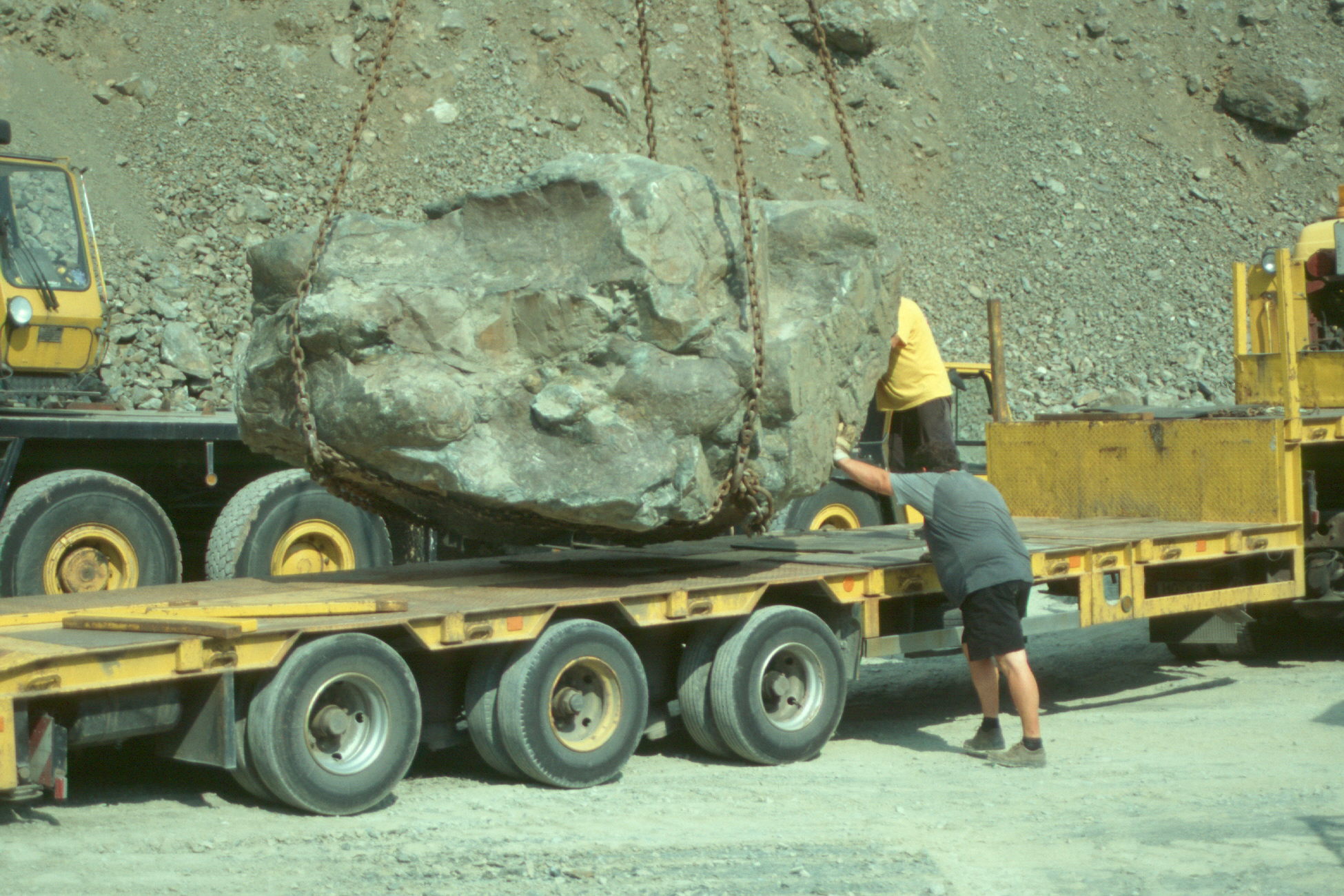
Magmatites, in turn, are divided into plutonic and volcanic exposures. Both rock types are represented by both mafic (dark) and felsic (light) specimens. The heaviest piece (30 tonnes) comes from Bad Berneck (Fichtelgebirge). This is a basaltic, submarine lava that shows pillow-like structures (so-called pillows).
Among the plutonic representatives, the Kösseine granite with its bluish feldspars is particularly beautifully formed.
The sediments are divided into clastic, chemical and biogenic materials. The clastic sediments are rocks that have been transported by water, wind or ice and are therefore formed differently depending on the transport medium. The Brannenburger Nagelfluh from Brannenburg am Inn and the sandstones from the Bernburg area with a wide variety of clearly formed depositional and sedimentary structures should be mentioned here as special features.
Chemical sediments are precipitated and deposited from the water under certain conditions, such as the anhydrite from Ilfeld. Biogenic sediments are often a mixed product of clastic or chemical sediments. High proportions of fossil material are typical, such as the Arieten limestone from the Lias á (Swabian Alb).
In the field of metamorphic rocks, there are representatives from the contact metamorphic area, such as the fruit slate from Theuma (Erzgebirge). Highly metamorphic specimens from the lower level of the continental crust come, for example, from the Black Forest (Oberharmersbach near Offenburg) or from the Münchberg Gneiss Massif (Münchberg near Hof).
Over 40 boulders from Scandinavia are exhibited in a smaller area. Here you will find a variety of materials ranging from weakly metamorphic sediments to highly metamorphic migmatites up to 2.1 billion years old.
Another area contains anthropogenic rocks, such as smelting products from copper slate mining (Mansfelder Land), historical, hewn building elements from Dresden, the Würzburg Residence and from the tower area of Cologne Cathedral, as well as mining exhibits, including a mining cave from Wimmelburg.
Geological features also form a special area of the Geological Garden. Several pieces of suevite from the Nördlinger Ries can be found here. This material, which was formed by a meteorite impact, is unique in Europe.
Flyer for the Geological Garden


© Dr. Thomas Degen

© Dr. Thomas Degen

© Dr. Thomas Degen

© Dr. Thomas Degen

© Dr. Thomas Degen

© Dr. Thomas Degen

© Dr. Thomas Degen
© Dr. Thomas Degen

© Dr. Thomas Degen

© Dr. Thomas Degen