
© ChatGPT 5.0
Background and goals
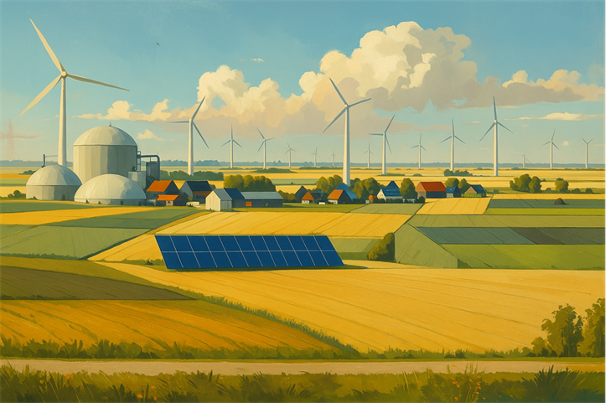
The cities of Heide, Rendsburg, Neumünster and Kiel and their surrounding municipalities want to become an important location for the processing of renewable energies in Europe with the “Clean Energy Valley” initiative. However, the change not only brings opportunities, but also new challenges: Who will be allowed to use which areas in future? How can the region remain liveable for everyone? Which ecological services will be affected by the energy transition? And where exactly should the journey actually take us? This is where the KoReGio100 junior research group comes in. It is setting up a so-called real-world laboratory – a place where research and practice work hand in hand. The aim is to work with people from the region to find ways in which urban and rural areas can be better organised together – sustainably, fairly and open to new ideas.
Sub-goals (optional)
“At ZALF, we are investigating how social conflicts that arise around the Clean Energy Valley can be dealt with,” explains Dr Meike Fienitz, who heads the junior research group together with Dr Katrin Martens from Humboldt-Universität zu Berlin. “It is crucial that local people can play an active role in shaping the project – which is why we are focussing on a co-design approach.” The geoecology working group focuses in particular on the negotiation of conflicts over natural resources between actors in the energy sector and the local population. The focus is on recording, analysing and modelling changes in the diverse services provided by ecosystems.
What other regions can learn from KoReGio100
The junior research group is not only developing solutions for the Clean Energy Valley – it also wants to find out how such changes can be well supported in other regions. To this end, the team is developing new tools and methods to harmonise social, ecological and economic interests. What makes it special: KoReGio100 links various topics – from environmental protection and social participation to the regional economy. The results should therefore also help local authorities, companies and initiatives facing similar challenges.
What happens with the new knowledge?
Over the next five years, the team wants to develop concrete recommendations for practical application:
- How can municipalities better organise participation?
- What strategies help to reduce tensions?
- And how can such processes be supported in the long term?
One thing is already clear: The energy transition will only succeed if it does not happen over people’s heads, but is organised together.
BMFTR junior research groups are teams of young scientists who have particularly innovative ideas and are allowed to research a topic independently – usually directly after completing their doctorate. The aim is to bring fresh impetus to research and at the same time further develop their own scientific path.


