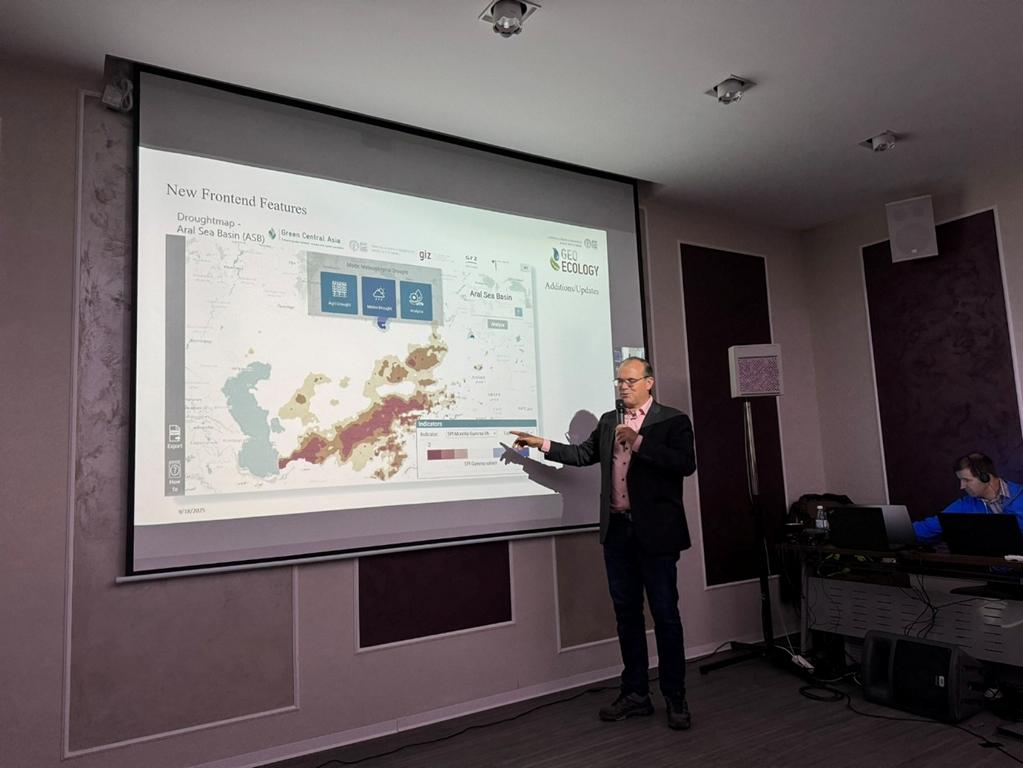
The Green Central Asia Workshop on the new developments in the Droughtmap-ASB monitoring tool took place on 17 and 18 September 2025 in Almaty, Kazakhstan. It was held by the Department of Geoecology at Martin Luther University Halle-Wittenberg (MLU) together with the Helmholtz Centre Potsdam – German Research Centre for Geosciences (GFZ) Potsdam and organised by GIZ. The MLU Halle-Wittenberg team included Prof Dr Christopher Conrad, Dr Muhammad Usman and Matthias Völkel, while Dr Tilo Schöne and Najib Kakar represented the GFZ Potsdam.
The aim of the workshop was to introduce the online tool Droughtmap-ASB for monitoring drought and water conditions in Central Asia and to present its new functions, including meteorological drought indicators. Another focus was on the integration of online data on water levels and volumes of numerous lakes and reservoirs, which the GFZ provides via the Sensor Data Storage System (SDSS).
Partners from water and agriculture ministries and regional hydrometeorological services took part in the training sessions and actively participated in discussions and feedback rounds. All five Central Asian countries – Kazakhstan, Kyrgyzstan, Tajikistan, Turkmenistan and Uzbekistan – were represented.
The participants recognised Droughtmap-ASB as a helpful tool for the agricultural, water and meteorological sectors. Partners from Kyrgyzstan and Tajikistan emphasised the need to map drought risks more accurately under near-natural vegetation conditions, while representatives from Kazakhstan pointed out the importance of the steppe ecosystems that predominate in their country. There were also calls for the inclusion of other transboundary river systems such as the Ili and Talas catchment areas, as the tool currently focuses primarily on the Aral Sea basin. In all countries, the participants identified relevant lakes and reservoirs that should be further processed in the SDSS and integrated into Droughtmap-ASB.
The workshop emphasised the strong regional commitment to the further development of drought monitoring, sustainable water management and climate resilience through scientific cooperation and intensive knowledge exchange.