
In 2016–2017, we excavated the Neolithic Daxie Site, on the eponymously named Daxie Island off the East China coast. The site has been recognized as the earliest sea-salt production site unearthed so far in China, where a specialized sea-salt industry emerged at ca. 2400 BCE and lasted for approximately 400 years. Intriguingly, the emergence of such a sea-salt industry occurred contemporaneously with the collapse of the prosperous Liangzhu society on the adjacent mainland. No less than nine Bronze Age salt-making sites are known to be located eastward of the Daxie Site, indicating the enduring nature of a sea-salt industry on the island. Salt is not only an essential component of the human diet, but it can provide the economic basis for a community and may even have promoted urbanization and the formation of early complex societies. Thus, the aim of this project is to reveal the technique of sea-salt making and adaptation strategy of Neolithic people to sea-level rise on East China coast at that time, as well as a reexamination of the social and cultural evolution of coastal East China following the demise of the Liangzhu State.
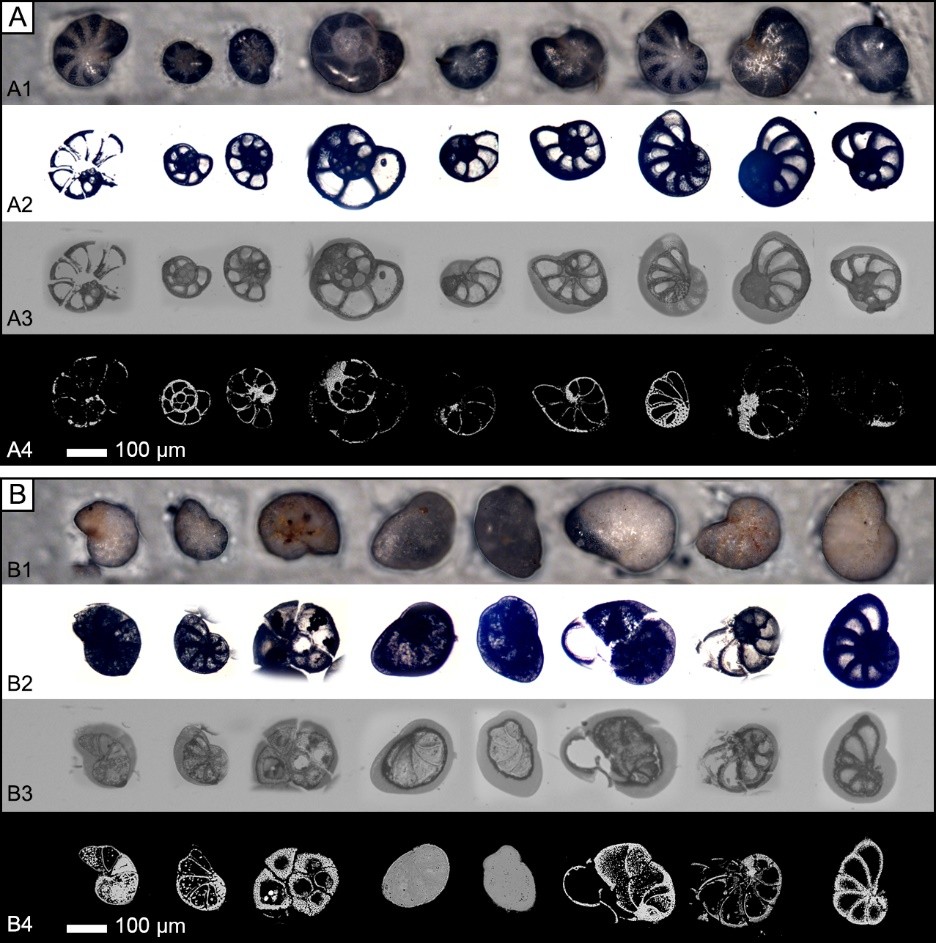
Images of (A) transparent foraminifera fossils in natural deposits and (B) mineral-infilled non-transparent foraminiferal fossils in discarded salty soil. A1 and B1 are the reflection images before polish. A2-4 and B2-4 are the images after polish, including the transmission images taken with an optical microscope (A2, B2), reflection images taken with an optical microscope (A3, B3), and backscattered electron (BSE) images taken with a scanning electron microscope (A4, B4). During polishing, not all fossils were sliced right from the middle due to different thicknesses of the test, leading to the difference from the original fossil shape, part of which may be contained within the resin substrate. The difference can be recognized in the reflection images (A3, B3), that the light grey part illustrates the fossil shapes and the dark grey part shows the polished surface layer. The transmission images (A2, B2) show the fossil shapes, and the darkness indicates the lower transparency of the fossils because of the infillings in the chambers. The BSE images (A4, B4) only show the morphology of the polished section.
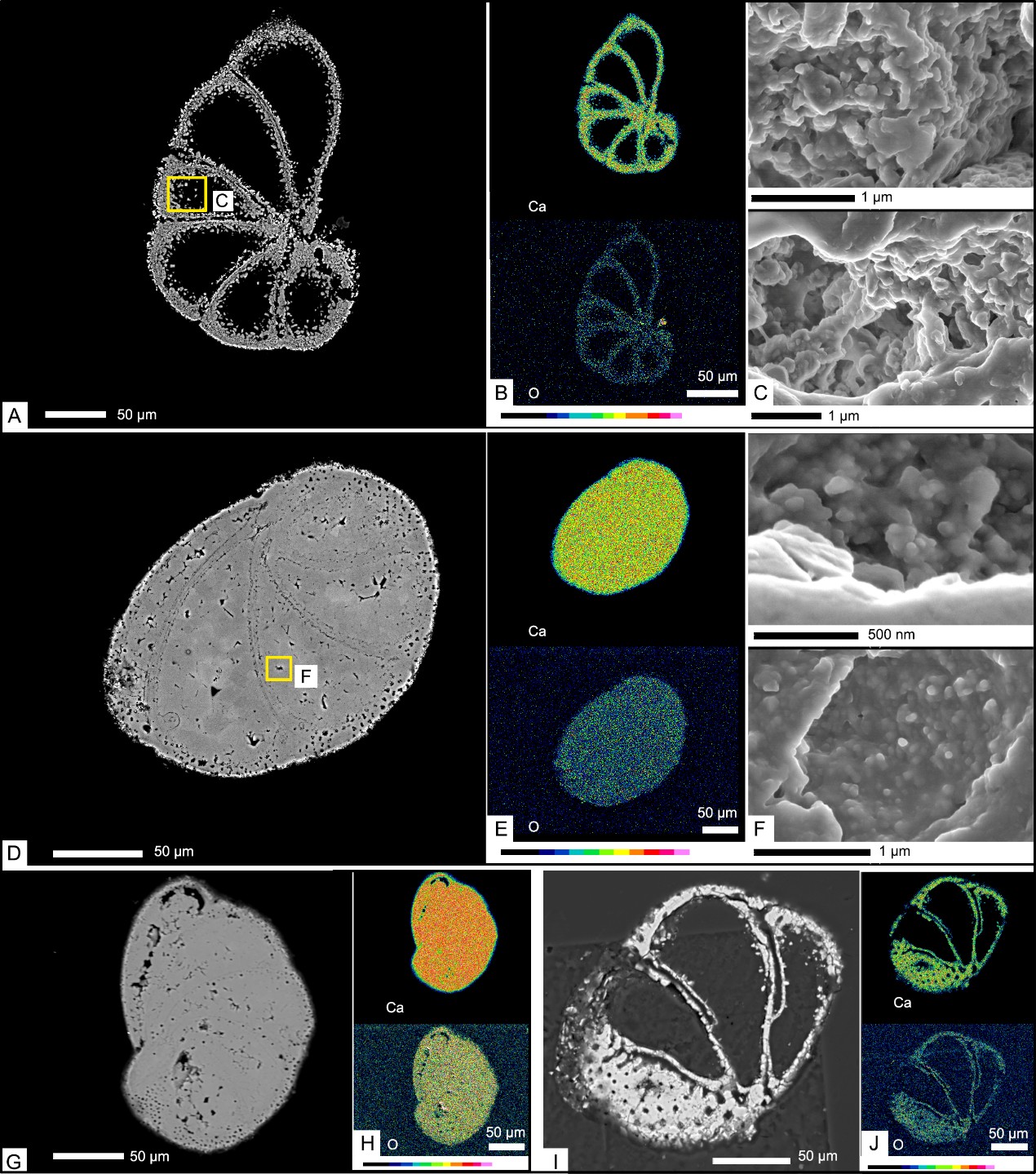
Backscattered electron (BSE) images of foraminifera (a, d, g, i), the relative weight percentage of main elements of the fossils (b, e, h, j), and micro-structures of the infilling minerals (c, f).

The relative sea-level rise (A; Wang et al., 2018), marine flooding recorded in the Liangzhu City (B; Zhang et al., 2022; He et al., 2021), and response of coastal societies (C-D) at ca. 2500e2400 BCE, including the transition from multiple subsistence of hunting, fishing, and stone-tool making to specialized sea-salt production on the elevated artificial mounds on the Daxie Island (C), and abandonment of the well-managed rice fields of the Liangzhu Culture, wharf and jade craft workshops in the Liangzhu City, and numerous Liangzhu settlements in the mainland (D).
Partners

