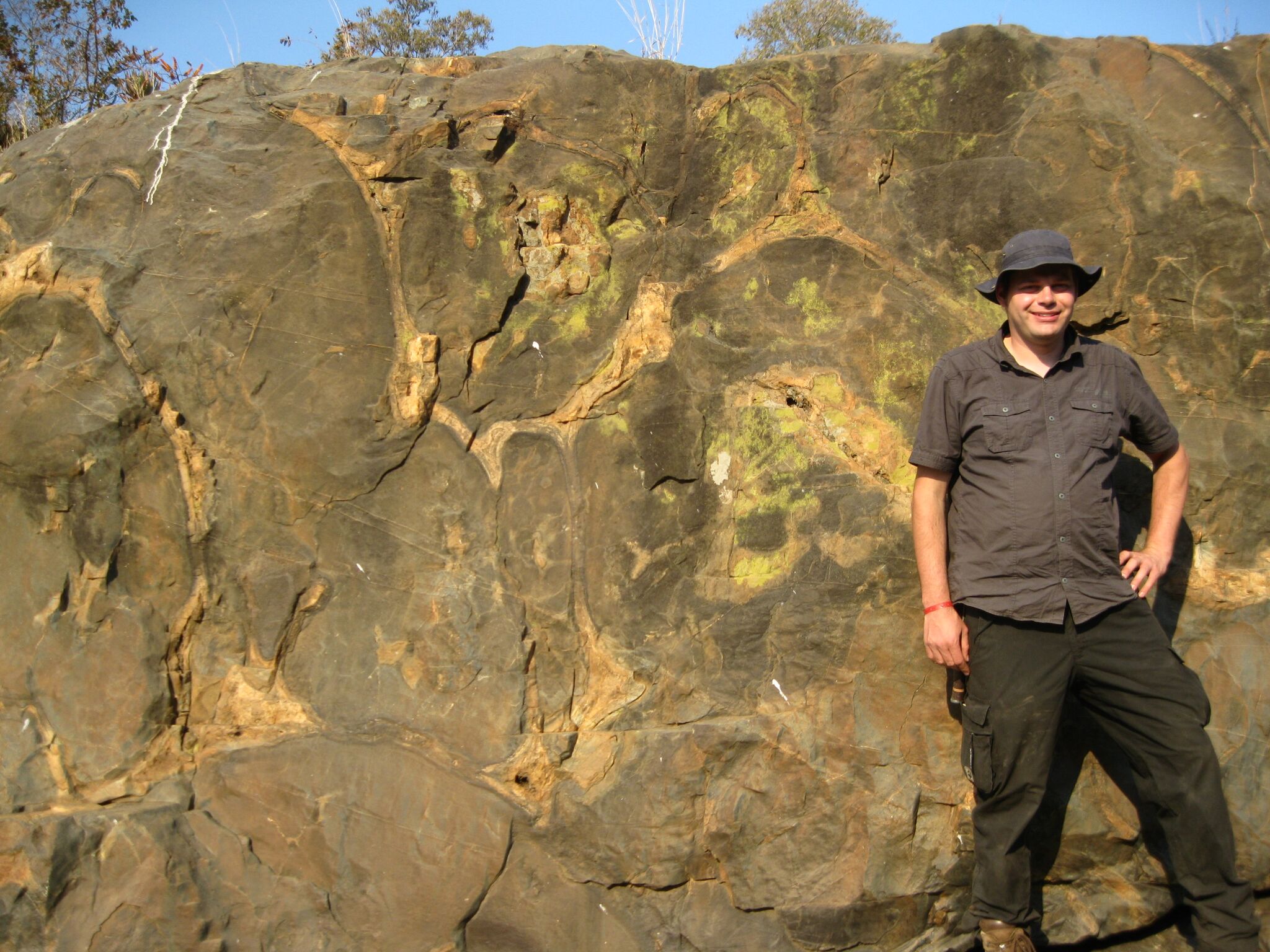
The oldest fragments preserved in Earth’s rock record are up to 4 billion years old. Owing to plate tectonics and the associated recycling of crustal material, these vestiges of the earliest stages of continental evolution are rare and have almost invariably been overprinted by secondary processes such as metamorphism, deformation, and migmatization. At a few exceptional localities,however, primary magmatic and sedimentary textures are still preserved.
Detailed field observations, combined with petrological and geochemical analyses, make it possible to recover primary information on the formation of continental crust and the geodynamic processes that shaped the early Earth. I will present case studies from Greenland and southern Africa that provide insights into the evolution of the early mantle–crust system and the processes involved in the formation and recycling of Earth’s first continental crust.
Biography
Elis Hoffmann is a research scientist and laboratory manager at Freie Universität Berlin. He holds a B.Sc. and M.Sc. from the University of Münster and a doctoral degree from the University of Bonn, and completed his habilitation at Freie Universität Berlin.
His research focuses on the formation of Earth’s early continental crust, the evolution of the mantle, and early crustal recycling processes. He combines fieldwork, petrology, and geochronology with stable and radiogenic isotope geochemistry to investigate the geodynamic evolution of the early Earth.