Skipt to content

DiP launches into the future of the bioeconomy with up to 105 million euros – geoecology involved in 3 projects

Post: Project : DiP launches into the future of the bioeconomy with up to 105 million euros – geoecology involved in 3 projects

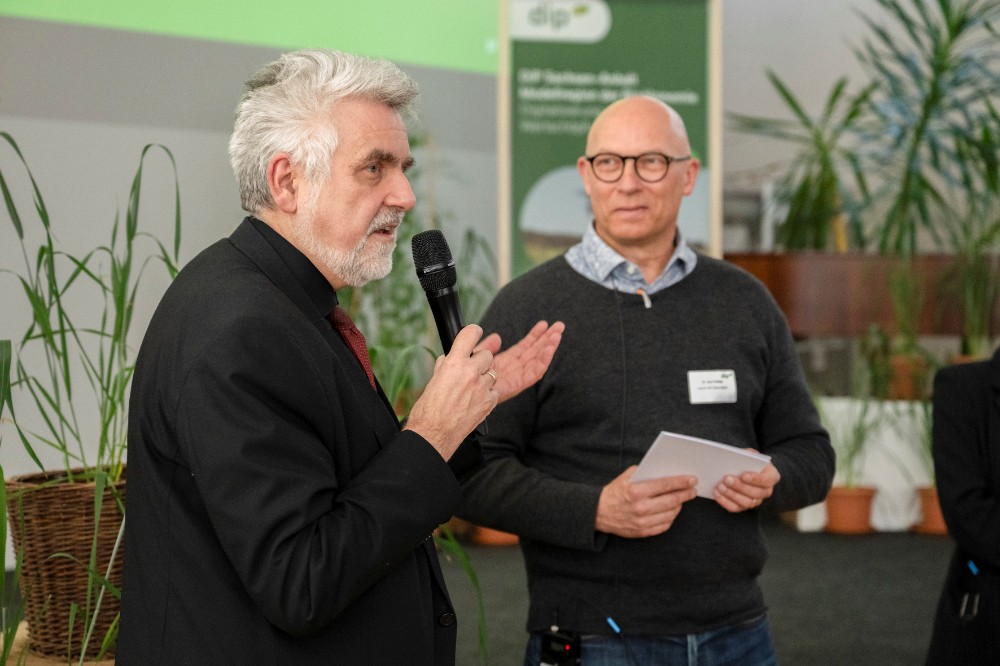
The south of Saxony-Anhalt is developing into a model region for a sustainable bioeconomy. At our official kick-off event for the “Digitalisation of Plant Value Chains” (DiP) on 4 March 2025, all 19 DiP joint projects were able to present themselves and engage in dialogue with stakeholders from the region. Together with around 50 partners from science and industry, we are working to develop innovative solutions for climate-resistant crops, sustainable cultivation systems and new value chains.

With funding of up to 105 million euros from the Federal Ministry of Education and Research (BMBF), our joint project aims to actively shape structural change in the Central German mining area and establish the region as a pioneer for the digitalised bioeconomy.

Saxony-Anhalt’s Science Minister Prof. Dr Armin Willingmann emphasised: “The abbreviation DiP stands for another lighthouse project with which we are shaping structural change in the course of the coal phase-out and also bringing Saxony-Anhalt forward in an absolute future topic.”

DiP spokesperson Prof. Dr Klaus Pillen from Martin Luther University Halle-Wittenberg, which is coordinating the project, emphasised the unique conditions in the region: “In the region, we have the best conditions and leading business partners to expand existing value chains and build new ones in an exemplary manner.”

Interested stakeholders from science, business, politics and society are cordially invited to network with DiP and work together to shape the future of the sustainable bioeconomy in the region.

As part of DiP, two projects in the Geoecology working group will be funded directly until 31 December 2028: DiP-SMART Agroforestry and DiP-FaiReSyst. We are represented in another DiP-ZAZIkI by Johannes Löw. Accordingly, numerous representatives of the Geoecology working group were present at the political kick-off: Prof Dr Christopher Conrad and Jan Lukas Wenzel reported on SMART Agroforst and Dr Julia Pöhlitz and Mona Pawelke presented the vision of the FaiReSyst project.

We are looking forward to the work in the coming years and want to make a significant contribution to structural change in the transformation region of southern Saxony-Anhalt with sustainably planted copses and field margins in the landscape.