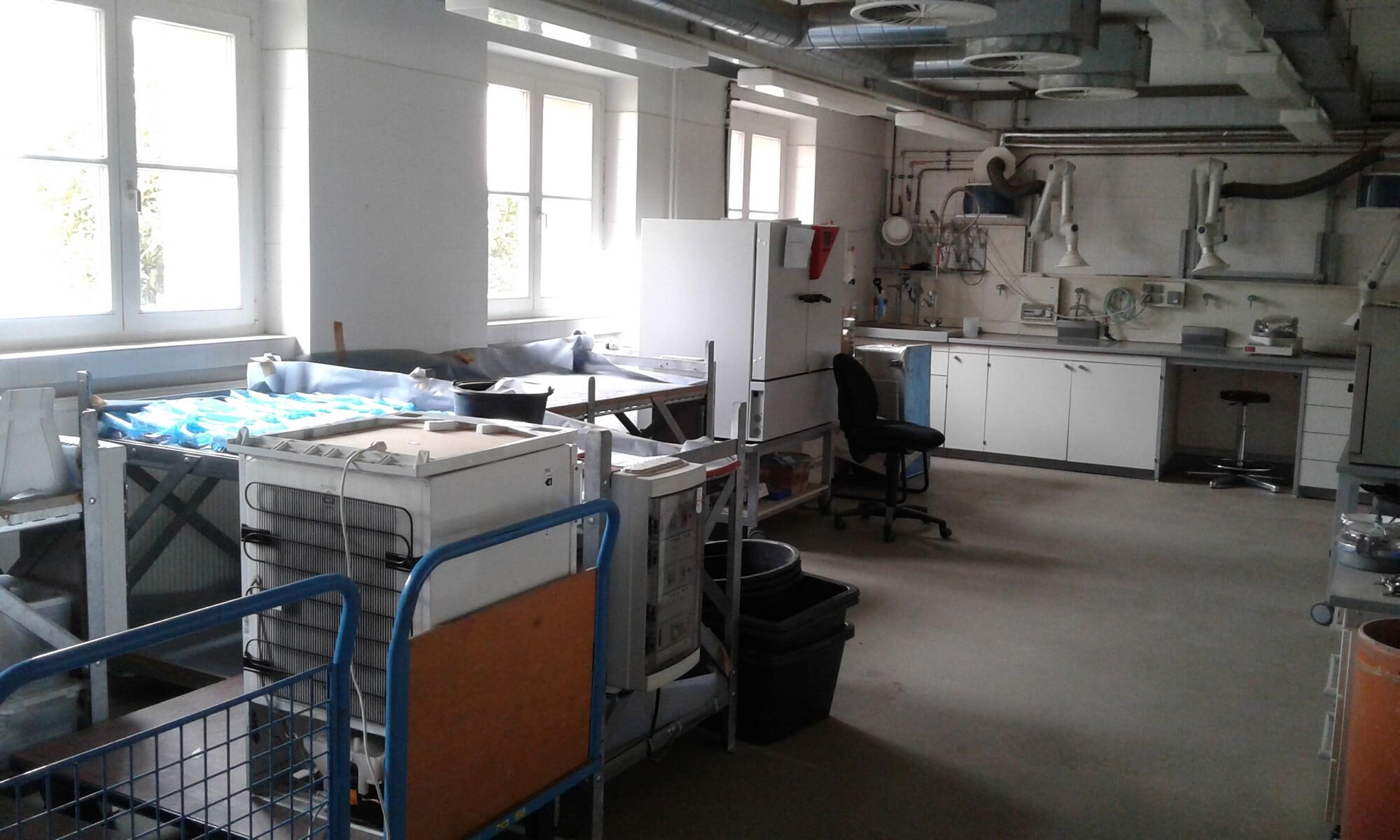
The geoecological laboratory is a facility of the “Geography” teaching area to which all working groups have access. However, the scientific and organisational management is carried out by Geoecology. It is used both for training students and for analysing samples from project-related and continuous research and observation. It specialises in water and soil chemistry on the one hand and soil physics and hydraulics on the other.
Soil physics and hydraulics
The infiltration rate (Kf value) on undisturbed soil samples using permeameters and the suction tension by applying negative pressure in the range from pF 1 to pF 2.9. Suction tension can be measured in pressure pots up to pF 4.2 (wilting point). Determination of particle size from 0.1 µm to 3.5 mm in 64 classes using laser diffraction in suspensions and in the air stream (dry dispersion). Determination of carbonate content in the soil is calculated using a disc and organic matter by means of loss on ignition. Lime as an aggregate-forming agent and organic matter in its quantity as a structure-forming agent are placed here for soil physics and hydraulics.
Water and soil chemistry
The determination of anions and cations in aqueous soil digestions and natural waters is carried out using ion chromatography. Two chromatographs are connected in series to measure the same aliquot when calculating ion balances. The determination of metals in digestions by aqua regia, plant-available metals and water-dissolved metals is realised by means of atomic absorption spectrometry in flame and graphite tube. Phosphates in the dissolved and undissolved phase. Digestion of total phosphorus and determination as ortho-phosphate after molybdate blue reaction in the UV-Vis spectrophotometer is another method of water and soil chemistry.