Skipt to content

Mineralogy & Geochemistry Laboratories Physicochemical analysis pH-stat method

Titration-elution process: pH-stat method

The pH-stat method is used to assess the mobilisability of mainly (heavy) metals and metal ions by elution in an aqueous medium at a constant pH value of 4 or 11. The simulated "worst case" conditions of the leaching of soils, waste materials or landfill material provide a long-term risk prognosis for the discharge of pollutants from solids and the pH value development of a leachate in a short time. Elution at pH 4 simulates the natural weather influence of "acid rain". In contrast, pH 11 comes close to mobilisation conditions such as those caused by alkaline leachates (e.g. in rust ash landfills) or humic substances (e.g. in eutrophic waters).

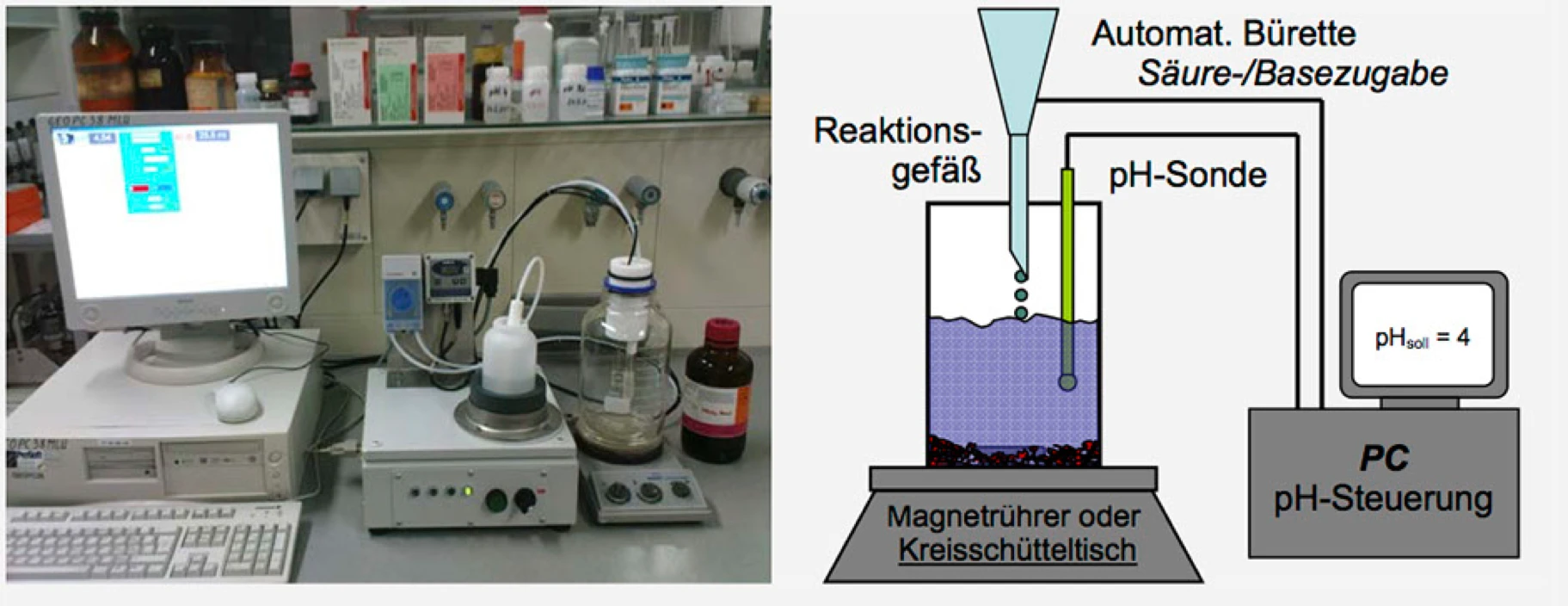
  • The solid is placed in a beaker with deionised water (in the ratio of its dry mass to liquid = 1:10). During the 24-hour elution, the suspension is kept in motion on a circular shaking table. The pH value is adjusted and kept constant by computer-aided end-point titration with HNO3 (pH4-stat) or NaOH (pH11-stat).
  • The eluate is then filtered (pressure filtration, 0.45 µm) and stabilised until analysis by acidification with HNO3 to pH < 2 or addition of EDTA.
  • The concentrations of mobilised elements in the eluate per initial mass of solid are a measure of its mobilisation capacity. The acid or base consumption during the titration determines the acid or base neutralisation capacity ANC24 or BNC24 of the solid after 24 hours. It enables the estimation of the pH value change of a leachate and the associated change in the solubility behaviour of pollutants over time.
This translation in English is 3 days and 1 hours older than the original version (Deutsch) and may be slightly outdated. → View original in Deutsch if you are looking for any new developments.