Skipt to content

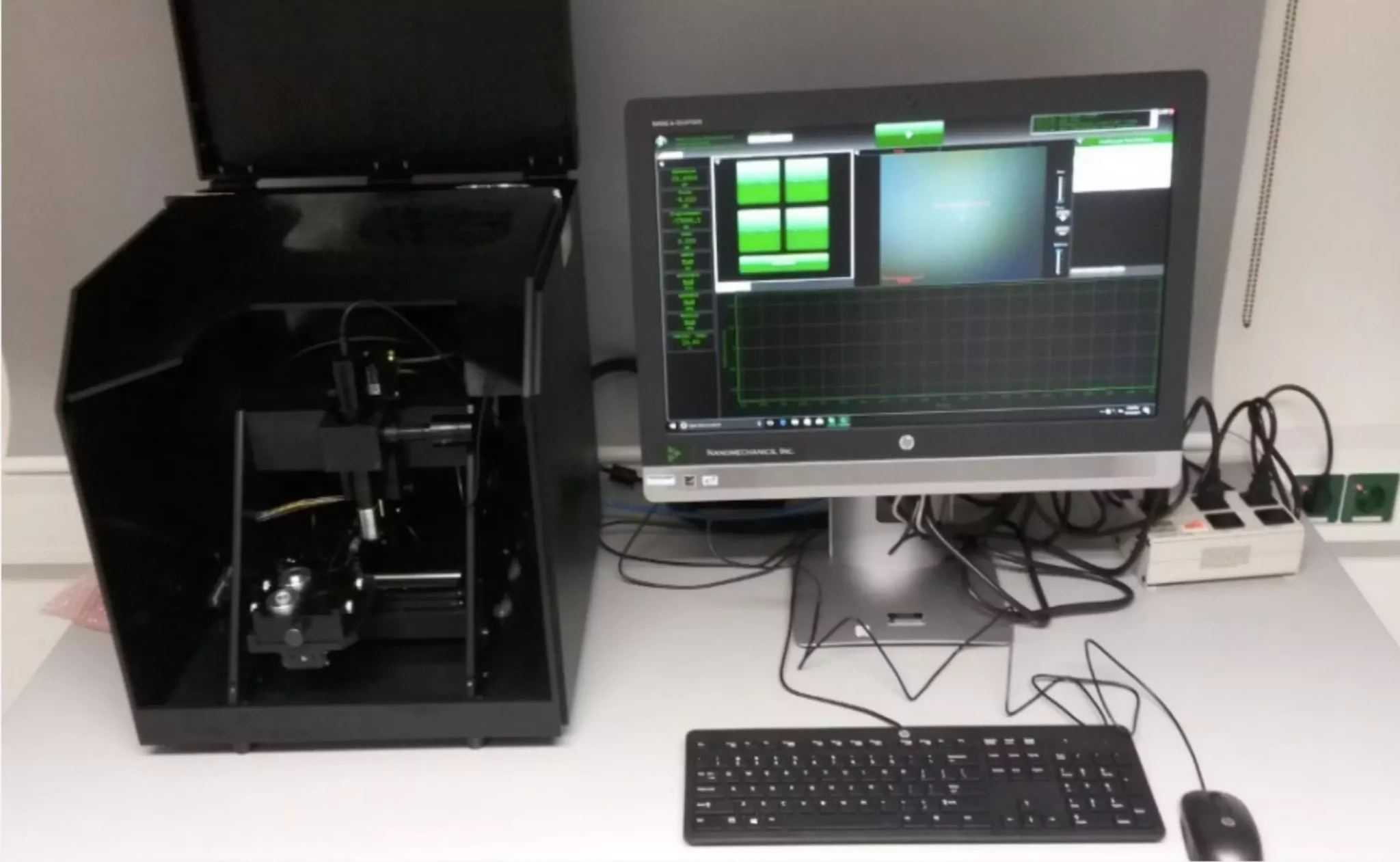
Mineralogy & Geochemistry Laboratories Structural analysis iNano® nanoindenter (Nanomechanics, Inc.)

Mechanical testing: iNano® nanoindenter (Nanomechanics, Inc.)

Nanoindentation is a precise measuring method for determining the mechanical properties of materials on a micrometre to nanometre scale. A very small tip, usually made of diamond, is pressed into the surface of a material with controlled force. Important parameters such as hardness and modulus of elasticity can be derived from the penetration depth and the applied load. Nanoindentation is frequently used in materials research, particularly for thin layers, nanomaterials and biological samples.

  • Displacement measurement: capacitive
  • Maximum penetration depth: 50 µm
  • Indentation accuracy: 0.0002 nm
  • Typical noise <0.1 nm
  • Maximum load: 50 mN
  • Force resolution: 3 nN
  • Damping coefficient: 0.05 Ns/m
  • Typical resonant frequency: 120 Hz

  • Data acquisition rate: 100 kHz
  • Closed-loop CPU control rate: 1 kHz
  • Time constant: 20 ES and higher
  • Dynamic excitation frequency: 0.1 Hz -1 kHz
  • Load Frame Stiffness: >1e6 N/m
  • Thermal drift: <= 0.05 nm/s

  • Geomaterials
  • Thin films
  • Metals, ceramics, polymers
  • composite materials
  • Biomaterials
  • Modulus and hardness (Oliver and Pharr method)
  • Continuous Stiffness Measurements
  • Constant Strain Rate
This translation in English is 3 days and 1 hours older than the original version (Deutsch) and may be slightly outdated. → View original in Deutsch if you are looking for any new developments.